Do math alarm apps work? An honest look at the evidence
Fair question to ask before you let an app hold your morning hostage over arithmetic. We make one of these apps, so read with that in mind — but the honest answer has a yes, two nos, and a setting that decides which one you get.
The short answer. Yes, for one specific failure: dismissing your alarm on autopilot and not remembering it. Arithmetic can’t be completed by a reflex, so the alarm can’t be silenced until the reasoning part of your brain is genuinely running. No, if you can solve problems lying down and fall back asleep, and no if the app can be killed by the mute switch or a force-quit. Difficulty and enforcement are what separate the two outcomes — not the arithmetic.
What math actually does at 6:45 AM
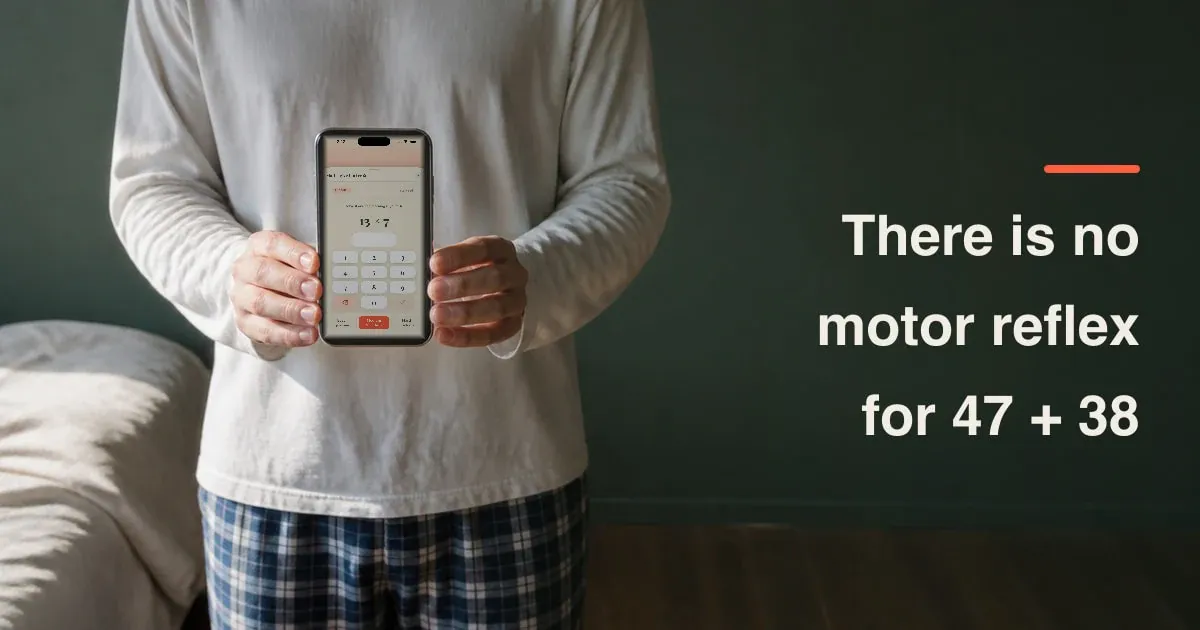
The problem a math mission attacks is precise: dismissing an alarm requires zero cognition, so your arm does it while your reasoning brain — the prefrontal cortex, the last region to boot after sleep — is still offline. There is no motor reflex for 47 + 38. Solving it forces working memory and attention online before silence is available, and those sixty to ninety seconds of forced cognition are the window in which sleep inertia loses its grip.
So: does arithmetic wake up the decision-making brain? Yes, reliably. That’s not marketing; that’s what working memory is.
What the evidence does and doesn’t say
Let’s be precise about the state of the research, because most pages on this topic aren’t.
What we could not find: a published controlled trial of math-based alarm apps. Nobody has randomised a few hundred people into “math alarm” and “normal alarm” groups and measured who got to work on time. Any page claiming otherwise is inventing it.
What is well established, and is directly relevant: arithmetic is one of the standard laboratory measures of how awake you are. Sleep-inertia researchers assess grogginess with addition and subtraction tasks precisely because performance on them tracks the return of prefrontal function — the recent snooze study, for instance, used arithmetic speed as one of its cognitive outcomes (Sundelin et al., Journal of Sleep Research, 2024). That cuts both ways, and it’s the honest core of the argument: if you can do the arithmetic, you are measurably more awake than someone who just swiped. And it’s why difficulty matters — a sum you can do at 20% capacity proves nothing.
What is also established: sleep inertia impairs judgement more than execution (Trotti, Sleep Medicine Reviews, 2017). Which is exactly why a decision-free reflex tap survives it and a task requiring working memory doesn’t.
Where math missions genuinely work
For the autopilot snoozer — the person who dismisses alarms with no memory of doing it — math missions attack the exact failure. The reflex tap stops producing silence; the loop breaks. This is the population where math alarms earn their reputation, and the app-level details live in alarm apps with math challenges.
The two honest failure cases
The horizontal solver. Some people solve three equations half-asleep, drop the phone, and are unconscious in ninety seconds. Cognition happened; elevation didn’t. If that’s you, math is the wrong mission — you need one that puts feet on floor, which is a different mechanism entirely: alarm apps that require getting out of bed.
The wrong difficulty. Too easy, and within a week the sums become part of the reflex they were meant to interrupt. Too hard, and you build alarm dread — or learn to hate the app enough to delete it. The fix is a difficulty you set the night before, locked so the morning negotiator can’t demote it.
How hard should the problems be?
The target is 30 to 90 seconds of genuine effort, and the calibration test is simple: if you can do it while lying down with your eyes half open, it’s too easy.
- Single-digit addition — too easy for anyone past week one. This is the setting that gives math alarms their bad reputation.
- Two-digit addition and subtraction — a reasonable starting point for most people.
- Two-digit multiplication, or a chain of several problems — where most habitual dismissers need to land.
- Anything you’d struggle with fully awake — too hard. Dread is what kills the habit, and an alarm you dread is an alarm you’ll disable on a bad night.
Escalate deliberately: raise the difficulty a notch the moment a morning starts feeling automatic, rather than after the first morning you miss.
Math versus the other missions
Math isn’t the only way to make silence expensive, and it isn’t always the right one.
| Mission | What it proves | Best for | Weakness |
|---|---|---|---|
| Math | Working memory is online | Autopilot dismissers | Solvable horizontally |
| Memory pattern | Attention and recall | People who find sums stressful | Same horizontal problem |
| Live Hunt | You are standing somewhere else | Sleeping through, crawling back | Needs a target you can’t reach from bed |
| Shake / movement | Physical activation | Grogginess more than dismissal | Can become mechanical |
| Typing an affirmation | Attention, plus a nudge to the day | Motivation-shaped mornings | Lightest of the set |
The best combination for a stubborn morning is usually one cognitive mission and one that requires distance — the arithmetic proves you’re thinking, the walk proves you’re up.
The setting that decides everything
A math mission in an app you can silence by muting the ringer or force-quitting is a puzzle, not an alarm. What makes the mission binding is the enforcement around it — re-ringing that treats every exit except the solved problem as an invitation to continue. That enforcement layer, not the arithmetic, is usually the difference between “worked for two weeks” and “worked”: mission-based alarm clock apps covers it.
The reliability problem nobody mentions
Read the store reviews of any math alarm app and the top complaint isn’t that the math is too easy. It’s that the alarm didn’t ring at all — the app was killed by the system overnight, or needed to be left open, or froze. An alarm that fires 95% of the time is not a 95%-good alarm; it’s a coin flip you can’t plan around.
So before judging whether missions work, check the boring things:
- On Android, exempt the app from battery optimisation and allow it to run in the background. This is the single most common cause of a silent morning.
- On iOS, keep notifications allowed and the app installed; modern alarm APIs let a properly built alarm ring through Silent and Focus, but permissions still have to be granted.
- Test it once, deliberately, with a five-minute alarm — including with the phone locked and the app closed.
- Don’t stack a mission app on top of your clock app’s alarm as a backup. The backup teaches you that the mission is optional.
How to set one up so it actually holds
- Pick your wake time honestly — the time you’ll get up, not the aspirational one.
- Set difficulty at two-digit arithmetic or harder, the night before, and lock it if the app allows.
- Turn on enforcement: re-ring after mute, face-down flip and force-quit.
- Put the phone across the room, so solving the problem happens standing.
- Add a second mission — a Live Hunt target in the kitchen — if you’re a known back-to-bed case.
- Give it two weeks before you judge it, and raise the difficulty the moment it feels automatic.
Verdict: math alarm apps work for the failure they target — autopilot dismissal — when the difficulty is honest and the exits are closed. They don’t fix sleep debt, and they don’t lift bodies out of bed. Know which problem is yours, and pick the mission accordingly.
Sources
- Sundelin T, Landry S, Axelsson J. Is snoozing losing? Why intermittent morning alarms are used and how they affect sleep, cognition, cortisol, and mood. Journal of Sleep Research, 2024.
- Trotti LM. Waking up is the hardest thing I do all day: sleep inertia and sleep drunkenness. Sleep Medicine Reviews, 2017.
- Robbins R, et al. Snooze alarm use in a global population of smartphone users. Scientific Reports, 2025.
Questions people actually ask
Do math alarm apps actually work?
For autopilot dismissal, yes — that is the failure they are built for, and the mechanism is sound. They do not fix sleep debt, they do not lift bodies out of bed, and they do not work when the difficulty is trivial or the exits are open.
Can you cheat a math alarm?
Usually, and that is the point of testing yours: a calculator on another device, a smartwatch dismiss, or just force-quitting the app. Whether cheating is available is an app decision, not a math decision — pick one that re-rings after every exit and keep the phone the only device in reach.
Is math the best mission type?
It is the best for the specific failure of dismissing without waking. If you sleep through alarms entirely, physical missions matter more; if you wake up and crawl back, distance matters more. Match the mission to the failure, not to the marketing.
Won't I just get used to the math?
Yes, if the difficulty stays put. Habituation applies to tasks exactly as it applies to sounds. Raise the difficulty when mornings start feeling automatic, and rotate mission types occasionally.
Are math alarms good for ADHD?
Often, because the failure they target — acting before the executive brain is engaged — is a familiar one. The caution is dread: a task that is too hard at 6:45 turns the alarm into something to avoid. Start easier than you think and escalate.
Is it bad to force your brain to do math right after waking?
No. You are not injuring anything — sleep inertia is a temporary state, and arithmetic is one of the standard ways researchers measure its retreat. If it feels stressful rather than merely annoying, that is a signal to lower the difficulty or switch mission types, not to go back to a swipe.