How to stop hitting snooze: a plan your morning self can't veto
Here’s the thing about every “just have more discipline” cure for snoozing: it schedules the discipline for the exact minute of the day you have the least of it. The alarm rings, and the plan meets a half-booted brain with a trained arm. The plan loses.
So don’t fight at dawn. Every change below is made the night before, and none of them can be vetoed by the sleepy negotiator.
The short version. Make dismissing the alarm require a task you can’t do half-asleep; close the mute-switch and force-quit exits so the task is the only way out; lock the difficulty at bedtime; put the phone where standing is mandatory; hold one wake time, weekends included. Then give the first ten minutes a shape, and — the change nobody wants to hear — move your bedtime rather than your alarm. Expect a week of friction before it feels normal.
1. Make silence cost something
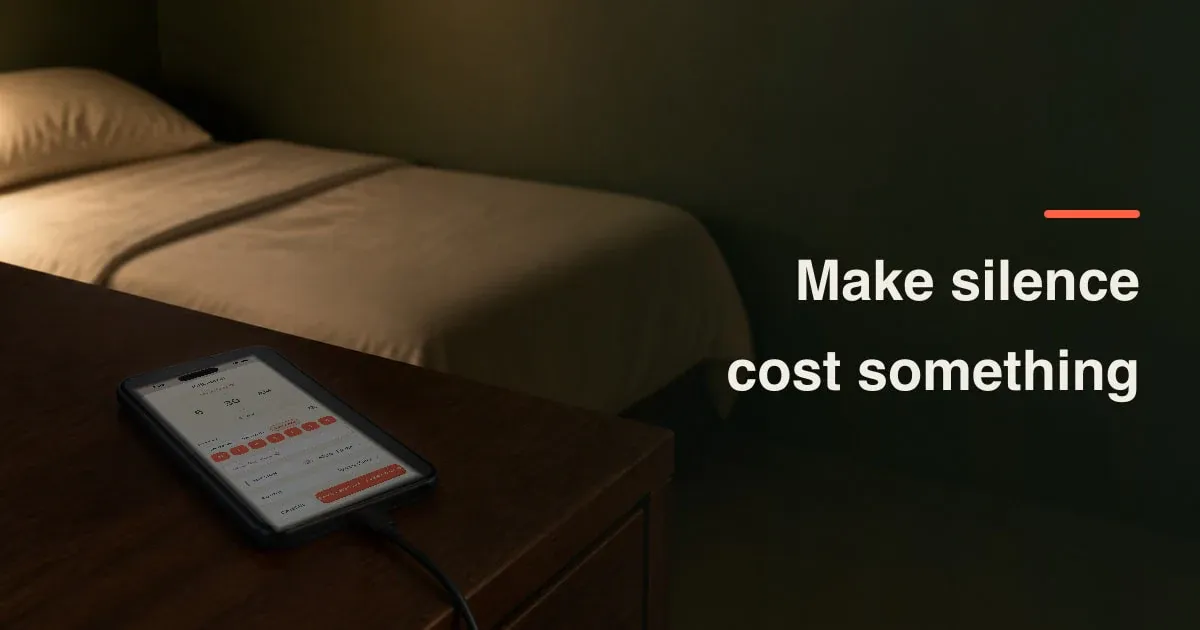
The snooze tap works because it’s free. Switch to an alarm where dismissal requires a verified task — arithmetic, a memory pattern, a Live Hunt target across the room. By the time the task is done, the front of your brain is running and the spiral has lost its window. That’s the entire premise of mission-based alarm apps, and for serial snoozers specifically it’s the difference-maker: the snoozer’s app guide.
Pick the mission that matches your failure. If you dismiss without remembering, you need a cognitive task — arithmetic is the classic, because there’s no motor reflex for 47 + 38. If you wake up fine and then crawl back, you need a physical one that ends with you standing in another room.
2. Close the side exits
A mission you can bypass with the mute switch is a suggestion, not a mission. Use an alarm that re-rings when silenced, flipped face-down, or force-quit — in Wake Boom that’s Relentless mode — so the only path to quiet runs through the task. The stricter category, and why it works psychologically, is covered in alarm apps that cannot be snoozed.
Run the audit tonight, awake: try to kill your alarm every way you can think of. Volume down, silent switch, face down, swipe the app away, airplane mode. Whichever one works is the one your reflex will find at 6:45 — it has all morning to look, and it isn’t tired.
3. Lock the difficulty in the evening
Decide tonight how hard tomorrow’s mission is. Difficulty that locks at bedtime means 6:45-you can’t demote “two-digit multiplication” to “tap OK.” You’re not being strict with yourself; you’re being strict with a stranger who shows up at dawn wearing your hands.
Aim for a task that takes 30 to 90 seconds. Under 30 and it becomes part of the reflex within a fortnight; over two minutes and you start dreading the alarm itself, which is how apps get deleted in week three.
4. Charge the phone across the room
Old advice, still undefeated: if dismissing the alarm requires standing, the hardest part of getting up happens before you’re awake enough to argue. Distance also makes Live Hunt missions honest — the target should need a walk, not a lean.
The trap is the return journey. Standing up is the win; walking back to a warm bed to “just sit down for a second” hands it straight back. Pair the distance with somewhere else to be — the kitchen, a light switch, the bathroom tap.
5. Keep one wake time
A body that knows when the ring comes starts surfacing before it: temperature and cortisol begin rising in anticipation, so the alarm lands in a lighter moment instead of ambushing you mid-deep-sleep. Pick the latest wake time your life honestly allows and hold it — including a soft version on weekends, within about an hour of the weekday time. Consistency converts the alarm from a daily ambush into a rhythm; the complete setup is in how to wake up on time with an alarm app.
6. Give the first ten minutes a shape
Sleep inertia degrades judgement long before it degrades execution — you can do things well before you can decide things. So don’t leave the first ten minutes to a brain that isn’t qualified to plan them. Choose tonight: clothes out, kettle filled, the first action obvious and physical. A morning with a script survives a fog that a morning with options does not.
This is also where snoozing quietly reveals itself as a motivation problem. Snooze use in the smartphone data peaks Monday to Friday and drops at weekends — the body isn’t more tired on a Tuesday. If nothing in your first hour is worth being awake for, put something there. It can be small and slightly ridiculous.
7. Move your bedtime, not your alarm
If you snooze for forty minutes every morning, you don’t own a 6:20 alarm. You own a 7:00 alarm with forty minutes of shredded sleep in front of it. Two honest options: set the alarm for when you actually get up and reclaim the sleep, or keep the early alarm and move bedtime back by the same amount. What doesn’t work is keeping both and hoping today is different.
Counting backwards is the whole method — pick the wake time, subtract seven and a half to eight hours, and treat the result as the appointment. An alarm cannot fix a bedtime.
8. Light and movement, immediately
The fastest known way to clear morning fog is to stand up and turn on light. Blood pressure and circulation shift the moment you’re vertical, and bright light suppresses the melatonin still arguing for another cycle. Curtains before coffee; coffee still works, but it has a twenty-minute lag, so it arrives to finish a job that standing and light have already started. The longer version is sleep inertia strategies.
If it still isn’t working
Three common failure modes, and what each one actually means:
- You complete the mission and get back into bed. Cognition happened; elevation didn’t. Swap the cognitive mission for a physical one two rooms away, and put something on the route — a light to turn on, a glass of water to drink.
- It worked for two weeks, then stopped. Habituation, every time. The sound has become furniture and the task has become reflex. Rotate the tone, raise the difficulty a notch, or let the app randomise the sound each morning.
- You’re snoozing through everything, most days. Then this isn’t a snooze problem — it’s sleep debt or something interrupting your sleep. Nothing in this list beats a body that’s two hours short, and unrefreshing sleep at a normal duration is worth a doctor’s opinion, not a louder ringtone. See why do I sleep through my alarm.
What about the gentler options?
Sunrise lamps, smart wake-up windows and gradual alarms all work on the same premise: wake you at a lighter moment, more pleasantly. If you wake easily and merely hate how it feels, they’re excellent. If your problem is that you dismiss alarms without waking, they’re the wrong tool — a gentle signal is the easiest kind to sleep through, and the easiest to dismiss on reflex. Get reliably up first, then make it gentler.
Expect the first week to be annoying. That’s not failure — that’s the habit dying. By week two the missions feel routine; by week three the streak does the motivating for you, one bloom per clean morning. The snooze button will still be there, technically. You just won’t be in a position to use it — which, at 6:45 AM, is the only kind of “won’t” that holds.
Sources
- Robbins R, et al. Snooze alarm use in a global population of smartphone users. Scientific Reports, 2025.
- Sundelin T, Landry S, Axelsson J. Is snoozing losing? Why intermittent morning alarms are used and how they affect sleep, cognition, cortisol, and mood. Journal of Sleep Research, 2024.
- Trotti LM. Waking up is the hardest thing I do all day: sleep inertia and sleep drunkenness. Sleep Medicine Reviews, 2017.
Questions people actually ask
How long does it take to stop snoozing?
Expect the first week to be genuinely annoying and the second to feel routine. The habit loop is short and heavily rehearsed, so it breaks quickly once the reward — instant silence — stops arriving. What takes longer is the sleep schedule underneath it, which needs two to three weeks to settle.
Is hitting snooze bad for you?
Once, then up, is not the disaster the internet claims — a 2024 study in the Journal of Sleep Research found 30 minutes of snoozing cost about six minutes of sleep and did not worsen morning cognition. Repeated snoozing across an hour is different: it fragments the REM-rich last hour of your night and restarts sleep inertia each time, so you arrive later and foggier.
Does putting the alarm across the room really help?
It is the highest-value free change on this list, because it converts a reflex into a walk. On its own it is beatable — plenty of people cross the room, dismiss, and return. Pair it with a mission and it stops being beatable.
What if I share a bed or a room?
Vibration plus a smartwatch tap handles most of it: a wrist alarm reaches you and nobody else. Keep the escalating-volume ring as backup, set to start quiet, and put the phone outside the bedroom door so the sound that eventually arrives is not at anyone's ear.
Should I just set fewer alarms?
Yes. Serial alarms train your brain that the first several are decorative — which is precisely the habituation you are trying to undo. One alarm, at the time you will actually get up, with no snooze available, beats five hopeful ones.
Do math alarm apps work for snoozing?
For the autopilot dismisser, yes — arithmetic cannot be completed by a reflex. For people who solve puzzles horizontally and fall back asleep, no. Our post on math alarm apps sets out the evidence and the two failure cases.